

Reconcile Event Registrations with Attendee Records
Match registrations, consent, payment state, access needs, attendance, and follow-up without merging uncertain identities.
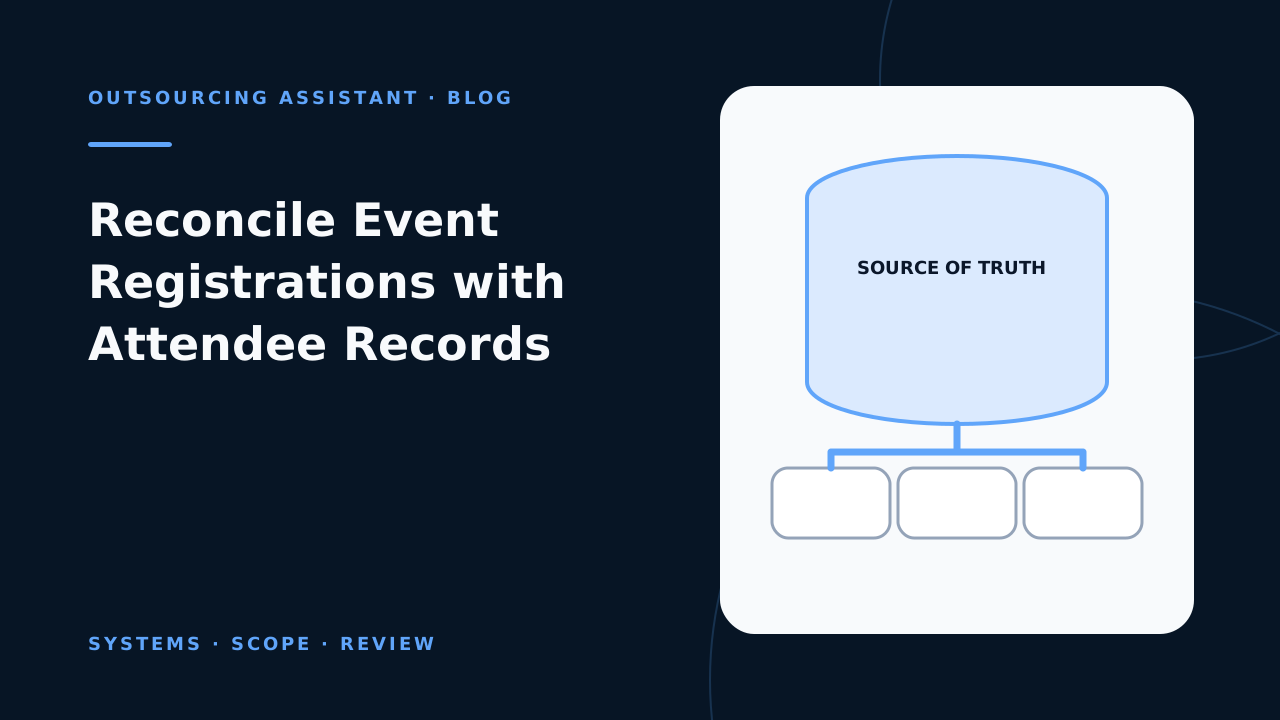
Define the work lane
Start when an online or hybrid event reaches a registration, reminder, admission, attendance, or post-event reconciliation checkpoint. Write the exact population, source systems, work window, owner, and finish evidence before access is granted. A general request to “handle this” is not a safe operating instruction. This reconcile event registrations with attendee records checkpoint should remain visible in the operating record.
For reconcile event registrations with attendee records, the working record contains registration identifier, attendee identity, organization, ticket or eligibility state, consent and communication choice, access request reference, attendance event, duplicate evidence, owner, and outcome. Required fields should support a decision, handoff, or audit; decorative data creates maintenance and privacy cost. This reconcile event registrations with attendee records checkpoint should remain visible in the operating record.
Separate preparation from authority
The assistant may reconcile approved fields and flag potential duplicates. Eligibility exceptions, refunds, accommodation decisions, privacy requests, and irreversible merges stay with authorized owners. Put the boundary where work occurs, with examples of the first safe action and the stop condition. This reconcile event registrations with attendee records checkpoint should remain visible in the operating record.
An interface permission does not create business authority. Record who requested the work, who may approve an exception, and who accepts the result when the accountable owner is absent. This reconcile event registrations with attendee records checkpoint should remain visible in the operating record.
Preserve sources and chronology
Link every material field in reconcile event registrations with attendee records to the authoritative source and version available at action time. Keep local time and zone where deadlines or customer promises matter. This reconcile event registrations with attendee records checkpoint should remain visible in the operating record.
Do not overwrite conflicting facts to make the tracker look complete. Preserve both values, label the uncertainty, and route the choice to the owner who can reconcile downstream systems. This reconcile event registrations with attendee records checkpoint should remain visible in the operating record.
Test an adverse case
Two registrations share an email domain and similar names but have different accessibility requests and ticket types. The assistant keeps both until identity evidence supports a merge. Treat the example as a rehearsal with actual roles, tools, and escalation channels rather than a discussion prompt. This reconcile event registrations with attendee records checkpoint should remain visible in the operating record.
Include a routine case, missing input, changed instruction, unavailable owner, downstream rejection, and correction after apparent completion. A happy path cannot validate the stop rule. This reconcile event registrations with attendee records checkpoint should remain visible in the operating record.
Use least privilege
Give the assistant named access to the smallest working set needed for reconcile event registrations with attendee records. Map exports, shared links, attachments, browser copies, automation credentials, and temporary files as well as the primary application. This reconcile event registrations with attendee records checkpoint should remain visible in the operating record.
Set review and expiry points. Sensitive values stay in approved systems; coordination notes use identifiers and status. Urgency does not justify collecting extra personal data or sharing secrets in chat. This reconcile event registrations with attendee records checkpoint should remain visible in the operating record.
Make handoffs executable
A handoff includes the source reference, work completed, open question, customer or stakeholder impact, next owner, due time, and acceptance receipt. Assigning a ticket is not proof that responsibility moved. This reconcile event registrations with attendee records checkpoint should remain visible in the operating record.
Use specific exception reasons such as missing source, identity conflict, stale version, absent approval, inaccessible evidence, deadline risk, or downstream rejection. Each reason needs a safe holding state. This reconcile event registrations with attendee records checkpoint should remain visible in the operating record.
Measure controls and outcomes
Review unmatched registrations, false duplicate candidates, payment conflicts, consent mismatches, admission failures, access requests routed, attendance linkage, and corrections. Keep denominators and separate assistant preparation time from owner, system, customer, vendor, and external wait. This reconcile event registrations with attendee records checkpoint should remain visible in the operating record.
A shorter queue is not improvement when work closes early, moves to private channels, or loses exception evidence. Pair aggregates with source-record samples and downstream receipts. This reconcile event registrations with attendee records checkpoint should remain visible in the operating record.
Close, clean up, and learn
Close reconcile event registrations with attendee records only when the approved action, authoritative record, owner acceptance, and outward communication agree. Reconcile reminders, duplicates, access, and temporary working copies. This reconcile event registrations with attendee records checkpoint should remain visible in the operating record.
Review failures after the first batch and after material policy, tool, staffing, or scope changes. Version the instruction, archive the superseded copy, brief affected roles, and retest a fresh example. This reconcile event registrations with attendee records checkpoint should remain visible in the operating record.
Keep planning
Questions people ask
What should the first assignment include?
Use one bounded case set with authoritative sources, a named owner, explicit stop rules, and observable finish evidence.
Can the assistant approve consequential action?
No. The assistant prepares and reconciles evidence; authorized owners retain consequential decisions.
What proves completion?
The exact approved version, authoritative downstream receipt, resolved exceptions, and verified access cleanup.
Reference notes
These links are a starting point for general context. They are not custom legal, tax, hiring, or cybersecurity advice.
- NIST Cybersecurity Framework 2.0: Governance, access, response, and recovery context.
- NIST Privacy Framework: Purpose-aware data processing and privacy-risk context.
- GAO Assessing Data Reliability: Source completeness and reliability questions.