

Evaluate Approval Delegation Coverage
Whether published approval windows have an available authorized decision maker across shifts, leave, and time zones under frozen definitions and explicit inference boundaries.
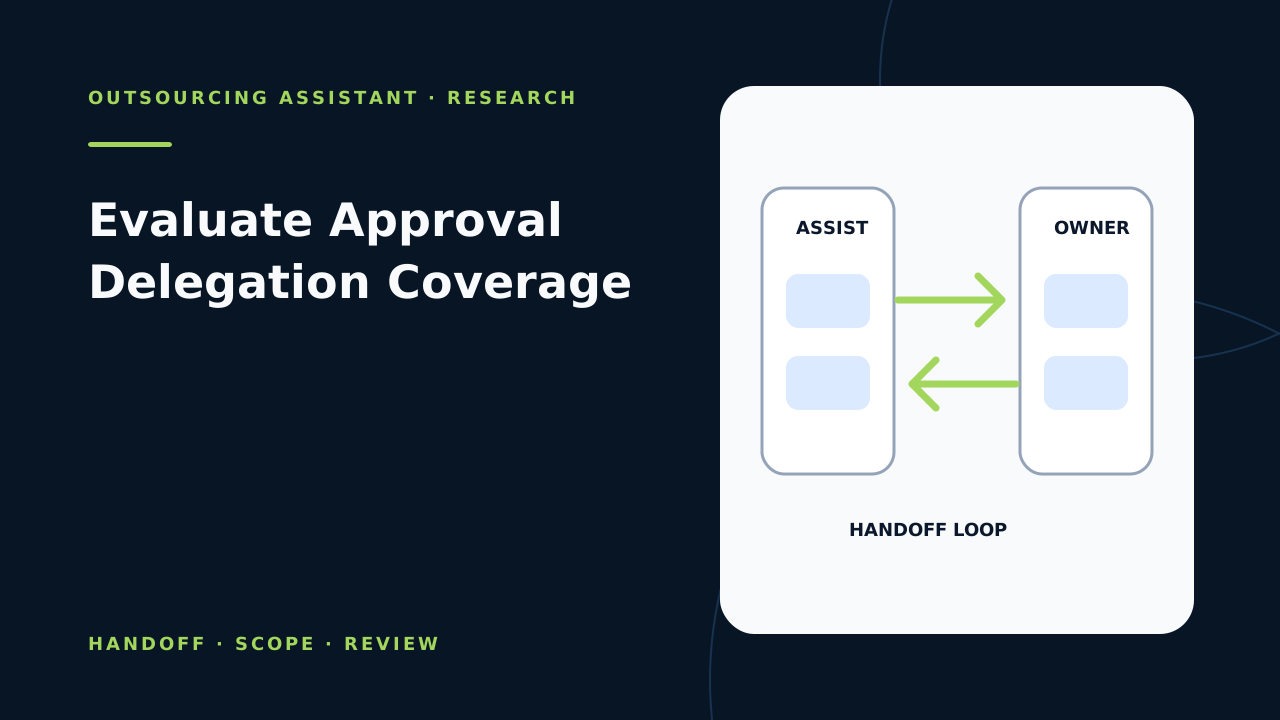
Headline statistic
One traceable observation per eligible delegated case
Methodology: A bounded observational protocol using ten authoritative HTTPS sources. Published October 13, 2026.
Key stats
- 10 authoritative HTTPS sources
- 2 independent review passes
- 1 preregistered decision rule
Key takeaways
- Define one ready-for-decision handoff assigned under the approved delegation schedule before extraction.
- Separate preparation, decision, action, and verification.
- Use findings for process repair, never personal scoring.
Research question and claim boundary
Published October 13, 2026. This study asks whether published approval windows have an available authorized decision maker across shifts, leave, and time zones. The unit is one ready-for-decision handoff assigned under the approved delegation schedule. It can describe patterns and control reliability under frozen definitions; it cannot prove causation, certify compliance, rank assistants, or establish an individual outcome. This analytical checkpoint belongs to evaluate approval delegation coverage and its unit: one ready-for-decision handoff assigned under the approved delegation schedule.
For the research question and claim boundary checkpoint in evaluate approval delegation coverage, record the exact source version, observed event, accountable owner, permitted action, destination receipt, unresolved uncertainty, next review time, and correction history. These fields preserve the distinction between evidence and interpretation for independent reconstruction. This analytical checkpoint belongs to evaluate approval delegation coverage and its unit: one ready-for-decision handoff assigned under the approved delegation schedule.
| Item | Finding or control | Source |
|---|---|---|
| Unit of analysis | one ready-for-decision handoff assigned under the approved delegation schedule | October 13 protocol |
| Decision use | repair alternate-owner coverage and readiness rules before promising shorter approval windows | October 13 protocol |
Source selection and method
Ten authoritative HTTPS sources from NIST, CISA, FTC, GAO, DOL, DOJ, and ISO provide identity, privacy, security, internal-control, recordkeeping, accessibility, and risk context. The method maps identity, provenance, observed state, decision authority, destination action, and verification. This analytical checkpoint belongs to evaluate approval delegation coverage and its unit: one ready-for-decision handoff assigned under the approved delegation schedule.
For the source selection and method checkpoint in evaluate approval delegation coverage, record the exact source version, observed event, accountable owner, permitted action, destination receipt, unresolved uncertainty, next review time, and correction history. These fields preserve the distinction between evidence and interpretation for independent reconstruction. This analytical checkpoint belongs to evaluate approval delegation coverage and its unit: one ready-for-decision handoff assigned under the approved delegation schedule.
| Item | Finding or control | Source |
|---|---|---|
| Unit of analysis | one ready-for-decision handoff assigned under the approved delegation schedule | October 13 protocol |
| Decision use | repair alternate-owner coverage and readiness rules before promising shorter approval windows | October 13 protocol |
Population and sampling frame
Define the eligible population before extraction and preserve its count. Include ordinary completions, missing evidence, unavailable owners, failed destinations, and reopened work. Use a documented random or systematic sample plus a separately labeled risk supplement; never call a risk sample representative. This analytical checkpoint belongs to evaluate approval delegation coverage and its unit: one ready-for-decision handoff assigned under the approved delegation schedule.
For the population and sampling frame checkpoint in evaluate approval delegation coverage, record the exact source version, observed event, accountable owner, permitted action, destination receipt, unresolved uncertainty, next review time, and correction history. These fields preserve the distinction between evidence and interpretation for independent reconstruction. This analytical checkpoint belongs to evaluate approval delegation coverage and its unit: one ready-for-decision handoff assigned under the approved delegation schedule.
| Item | Finding or control | Source |
|---|---|---|
| Unit of analysis | one ready-for-decision handoff assigned under the approved delegation schedule | October 13 protocol |
| Decision use | repair alternate-owner coverage and readiness rules before promising shorter approval windows | October 13 protocol |
Data model and lineage
The proposed record contains handoff ID, ready time, required authority, primary owner, alternate owner, acceptance, decision time, and exception. It also needs source system, definition, time zone, extraction time, transformation, owner, missing-value meaning, correction history, retention rule, and dataset version. A reviewer should trace sampled rows to source and back. This analytical checkpoint belongs to evaluate approval delegation coverage and its unit: one ready-for-decision handoff assigned under the approved delegation schedule.
For the data model and lineage checkpoint in evaluate approval delegation coverage, record the exact source version, observed event, accountable owner, permitted action, destination receipt, unresolved uncertainty, next review time, and correction history. These fields preserve the distinction between evidence and interpretation for independent reconstruction. This analytical checkpoint belongs to evaluate approval delegation coverage and its unit: one ready-for-decision handoff assigned under the approved delegation schedule.
| Item | Finding or control | Source |
|---|---|---|
| Unit of analysis | one ready-for-decision handoff assigned under the approved delegation schedule | October 13 protocol |
| Decision use | repair alternate-owner coverage and readiness rules before promising shorter approval windows | October 13 protocol |
Findings framework
Separate the initiating request, assistant preparation, owner decision, system action, stakeholder communication, and verified outcome. A reminder can be delivered without a decision; a task can close without owner acceptance; a removal ticket can finish while residual access remains. This analytical checkpoint belongs to evaluate approval delegation coverage and its unit: one ready-for-decision handoff assigned under the approved delegation schedule.
For the findings framework checkpoint in evaluate approval delegation coverage, record the exact source version, observed event, accountable owner, permitted action, destination receipt, unresolved uncertainty, next review time, and correction history. These fields preserve the distinction between evidence and interpretation for independent reconstruction. This analytical checkpoint belongs to evaluate approval delegation coverage and its unit: one ready-for-decision handoff assigned under the approved delegation schedule.
| Item | Finding or control | Source |
|---|---|---|
| Unit of analysis | one ready-for-decision handoff assigned under the approved delegation schedule | October 13 protocol |
| Decision use | repair alternate-owner coverage and readiness rules before promising shorter approval windows | October 13 protocol |
Analysis plan
Publish population flow, denominators, missingness, distributions, medians, tail measures, and absolute differences. Keep assistant handling distinct from owner, stakeholder, vendor, and system wait. Disclose any model specification, reference groups, diagnostics, and sensitivity tests. This analytical checkpoint belongs to evaluate approval delegation coverage and its unit: one ready-for-decision handoff assigned under the approved delegation schedule.
For the analysis plan checkpoint in evaluate approval delegation coverage, record the exact source version, observed event, accountable owner, permitted action, destination receipt, unresolved uncertainty, next review time, and correction history. These fields preserve the distinction between evidence and interpretation for independent reconstruction. This analytical checkpoint belongs to evaluate approval delegation coverage and its unit: one ready-for-decision handoff assigned under the approved delegation schedule.
| Item | Finding or control | Source |
|---|---|---|
| Unit of analysis | one ready-for-decision handoff assigned under the approved delegation schedule | October 13 protocol |
| Decision use | repair alternate-owner coverage and readiness rules before promising shorter approval windows | October 13 protocol |
Bias and alternatives
Test selection from excluded failures, missing off-platform events, definition drift, timezone defaults, changed workload, policy releases, outages, and reviewer knowledge of outcomes. A zero count can mean absence or failed detection. Preserve conflicting sources until an owner resolves them. This analytical checkpoint belongs to evaluate approval delegation coverage and its unit: one ready-for-decision handoff assigned under the approved delegation schedule.
For the bias and alternatives checkpoint in evaluate approval delegation coverage, record the exact source version, observed event, accountable owner, permitted action, destination receipt, unresolved uncertainty, next review time, and correction history. These fields preserve the distinction between evidence and interpretation for independent reconstruction. This analytical checkpoint belongs to evaluate approval delegation coverage and its unit: one ready-for-decision handoff assigned under the approved delegation schedule.
| Item | Finding or control | Source |
|---|---|---|
| Unit of analysis | one ready-for-decision handoff assigned under the approved delegation schedule | October 13 protocol |
| Decision use | repair alternate-owner coverage and readiness rules before promising shorter approval windows | October 13 protocol |
Reviewer agreement
Give independent reviewers the same source packet and require field-level classes plus uncertainty. Report disagreement on consequential fields, not only an overall rate. Clarify ambiguous definitions and test a fresh blinded sample rather than privately pressuring reviewers to agree. This analytical checkpoint belongs to evaluate approval delegation coverage and its unit: one ready-for-decision handoff assigned under the approved delegation schedule.
For the reviewer agreement checkpoint in evaluate approval delegation coverage, record the exact source version, observed event, accountable owner, permitted action, destination receipt, unresolved uncertainty, next review time, and correction history. These fields preserve the distinction between evidence and interpretation for independent reconstruction. This analytical checkpoint belongs to evaluate approval delegation coverage and its unit: one ready-for-decision handoff assigned under the approved delegation schedule.
| Item | Finding or control | Source |
|---|---|---|
| Unit of analysis | one ready-for-decision handoff assigned under the approved delegation schedule | October 13 protocol |
| Decision use | repair alternate-owner coverage and readiness rules before promising shorter approval windows | October 13 protocol |
Privacy, fairness, and governance
Collect only fields required for the stated decision, replace direct identifiers with study keys, restrict the crosswalk, and apply approved retention. Suppress or aggregate small groups where appropriate. Do not infer protected traits, intent, loyalty, or capability from administrative traces. This analytical checkpoint belongs to evaluate approval delegation coverage and its unit: one ready-for-decision handoff assigned under the approved delegation schedule.
For the privacy, fairness, and governance checkpoint in evaluate approval delegation coverage, record the exact source version, observed event, accountable owner, permitted action, destination receipt, unresolved uncertainty, next review time, and correction history. These fields preserve the distinction between evidence and interpretation for independent reconstruction. This analytical checkpoint belongs to evaluate approval delegation coverage and its unit: one ready-for-decision handoff assigned under the approved delegation schedule.
| Item | Finding or control | Source |
|---|---|---|
| Unit of analysis | one ready-for-decision handoff assigned under the approved delegation schedule | October 13 protocol |
| Decision use | repair alternate-owner coverage and readiness rules before promising shorter approval windows | October 13 protocol |
Robustness and replication
Repeat analysis after restoring eligible missing cases, excluding disrupted periods, and varying only predefined reasonable thresholds. Archive the preregistration, population logic, dictionary, extraction version, exclusions, review worksheet, disagreements, analysis specification, and sensitivities. This analytical checkpoint belongs to evaluate approval delegation coverage and its unit: one ready-for-decision handoff assigned under the approved delegation schedule.
For the robustness and replication checkpoint in evaluate approval delegation coverage, record the exact source version, observed event, accountable owner, permitted action, destination receipt, unresolved uncertainty, next review time, and correction history. These fields preserve the distinction between evidence and interpretation for independent reconstruction. This analytical checkpoint belongs to evaluate approval delegation coverage and its unit: one ready-for-decision handoff assigned under the approved delegation schedule.
| Item | Finding or control | Source |
|---|---|---|
| Unit of analysis | one ready-for-decision handoff assigned under the approved delegation schedule | October 13 protocol |
| Decision use | repair alternate-owner coverage and readiness rules before promising shorter approval windows | October 13 protocol |
Decision rule and limitations
The operational decision is whether to repair alternate-owner coverage and readiness rules before promising shorter approval windows. Predefine what triggers repair, continued observation, or no change. Local systems, contracts, task mix, policy versions, languages, access boundaries, and missing evidence limit generalization; association does not establish cause. This analytical checkpoint belongs to evaluate approval delegation coverage and its unit: one ready-for-decision handoff assigned under the approved delegation schedule.
For the decision rule and limitations checkpoint in evaluate approval delegation coverage, record the exact source version, observed event, accountable owner, permitted action, destination receipt, unresolved uncertainty, next review time, and correction history. These fields preserve the distinction between evidence and interpretation for independent reconstruction. This analytical checkpoint belongs to evaluate approval delegation coverage and its unit: one ready-for-decision handoff assigned under the approved delegation schedule.
| Item | Finding or control | Source |
|---|---|---|
| Unit of analysis | one ready-for-decision handoff assigned under the approved delegation schedule | October 13 protocol |
| Decision use | repair alternate-owner coverage and readiness rules before promising shorter approval windows | October 13 protocol |
Research notes
Published October 13, 2026. This protocol examines whether published approval windows have an available authorized decision maker across shifts, leave, and time zones.
Its decision purpose is to repair alternate-owner coverage and readiness rules before promising shorter approval windows.
Apply the protocol to a controlled assistant lane
Start with a bounded queue, explicit authority, preserved sources, and a named decision owner.
Use the first observation period to test the protocol before expanding scope.
Questions people ask
What is the unit of analysis?
The proposed unit is one ready-for-decision handoff assigned under the approved delegation schedule.
Does this establish causation?
No. It is a bounded observational protocol with explicit alternative explanations.
How should results be used?
Use findings to repair alternate-owner coverage and readiness rules before promising shorter approval windows.
Sources
- NIST Cybersecurity Framework 2.0: Governance and risk-management context.
- NIST Privacy Framework: Purpose-aware data processing and privacy-risk context.
- NIST Digital Identity Guidelines: Identity and authentication context.
- CISA Multifactor Authentication Guidance: Practical account protection guidance.
- FTC Protecting Personal Information: Business data protection and minimization context.
- GAO Assessing Data Reliability: Source fitness, completeness, and reliability questions.
- GAO Standards for Internal Control: Control environment, information, and monitoring criteria.
- Department of Labor Recordkeeping: Official recordkeeping context.
- DOJ Web Accessibility Guidance: Accessible digital communication context.
- ISO 31000 Risk Management: Risk identification and treatment context.