

Evaluate Approval Window Reliability for Assistant Handoffs
A practical study design for testing whether promised approval windows are genuinely usable by delegated teams.
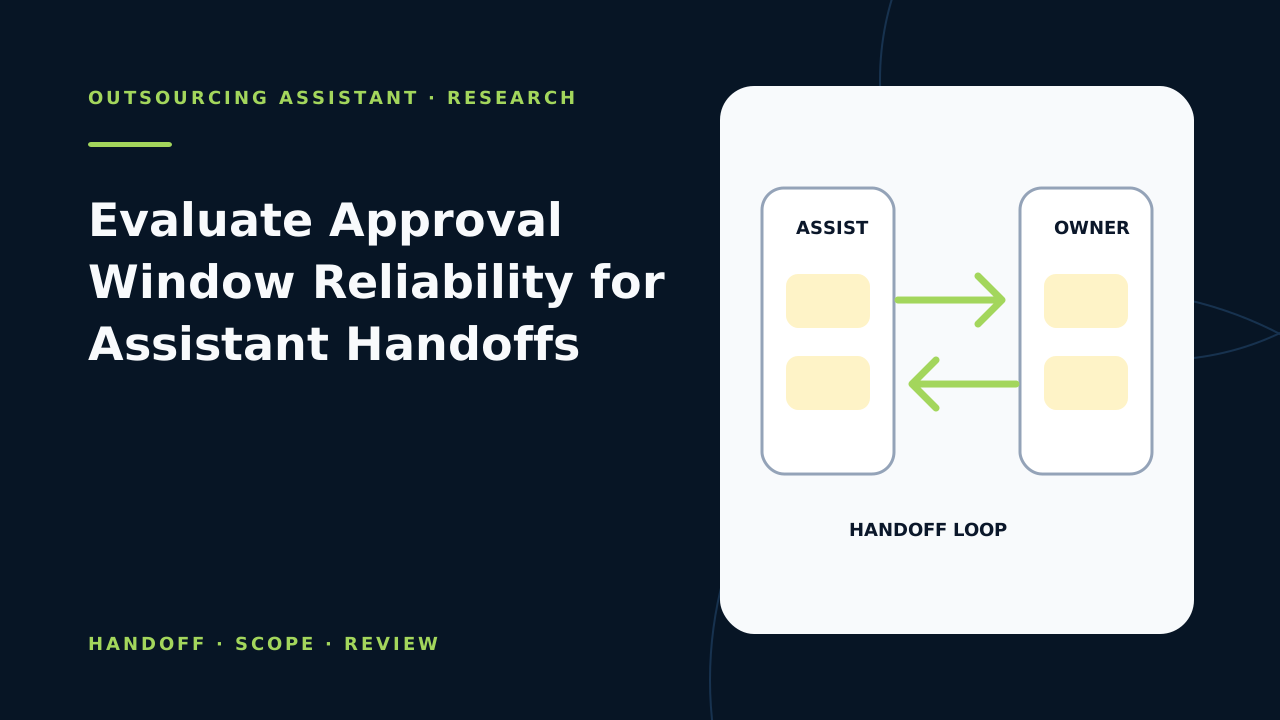
Headline statistic
One traceable observation per eligible case
Methodology: A bounded observational review of assistant-prepared handoffs assigned to a named authorized approver with a recorded ready time and due window. Published October 12, 2026.
Key stats
- One fixed eligibility rule
- One preserved denominator
- Ten authoritative context sources
Key takeaways
- Measure whether ready handoffs receive a valid decision inside the published approval window.
- Separate the likely confounders: work submitted after cutoff, missing evidence, wrong approver, and system downtime can distort the observed result.
- Use findings to decide whether to adjust capacity, cutoffs, alternate approvers, readiness checks, or exception routing.
Research question and claim boundary
For evaluate approval window reliability for assistant handoffs, examine the exact operational question, intended decision, and claims the observations can and cannot support. The study question is whether ready handoffs receive a valid decision inside the published approval window. Use a written protocol before sampling so a surprising case cannot silently redefine eligibility, timing, or success. Preserve the source identifiers, observation time, operating context, and reviewer decision for every included item. This makes the finding reviewable and keeps a local process study from becoming an unsupported universal claim.
Do not treat a descriptive review as proof that outsourcing, location, or any individual caused the result. In this study, the primary finding to test is that an advertised window is reliable only when authority, access, and capacity exist for the cases routed into it. Report missing records and disagreements as results rather than filling gaps from memory. A transparent limitation is more useful than a precise-looking rate whose denominator, authority boundary, or evidence trail cannot be reconstructed.
| Item | Finding or control | Source |
|---|---|---|
| Study population | assistant-prepared handoffs assigned to a named authorized approver with a recorded ready time and due window | This review protocol |
| Decision use | whether to adjust capacity, cutoffs, alternate approvers, readiness checks, or exception routing | This review protocol |
Population and sampling frame
For evaluate approval window reliability for assistant handoffs, examine the eligible population: assistant-prepared handoffs assigned to a named authorized approver with a recorded ready time and due window. The study question is whether ready handoffs receive a valid decision inside the published approval window. Use a written protocol before sampling so a surprising case cannot silently redefine eligibility, timing, or success. Preserve the source identifiers, observation time, operating context, and reviewer decision for every included item. This makes the finding reviewable and keeps a local process study from becoming an unsupported universal claim.
Freeze the period and inclusion rule before reviewing outcomes; retain exclusions with reason codes and final dispositions. In this study, the primary finding to test is that an advertised window is reliable only when authority, access, and capacity exist for the cases routed into it. Report missing records and disagreements as results rather than filling gaps from memory. A transparent limitation is more useful than a precise-looking rate whose denominator, authority boundary, or evidence trail cannot be reconstructed.
| Item | Finding or control | Source |
|---|---|---|
| Study population | assistant-prepared handoffs assigned to a named authorized approver with a recorded ready time and due window | This review protocol |
| Decision use | whether to adjust capacity, cutoffs, alternate approvers, readiness checks, or exception routing | This review protocol |
Operational definitions
For evaluate approval window reliability for assistant handoffs, examine observable start, stop, pause, completion, exception, and authority states. The study question is whether ready handoffs receive a valid decision inside the published approval window. Use a written protocol before sampling so a surprising case cannot silently redefine eligibility, timing, or success. Preserve the source identifiers, observation time, operating context, and reviewer decision for every included item. This makes the finding reviewable and keeps a local process study from becoming an unsupported universal claim.
Define clocks from system events where possible and have two reviewers resolve ambiguous cases against the same written rule. In this study, the primary finding to test is that an advertised window is reliable only when authority, access, and capacity exist for the cases routed into it. Report missing records and disagreements as results rather than filling gaps from memory. A transparent limitation is more useful than a precise-looking rate whose denominator, authority boundary, or evidence trail cannot be reconstructed.
| Item | Finding or control | Source |
|---|---|---|
| Study population | assistant-prepared handoffs assigned to a named authorized approver with a recorded ready time and due window | This review protocol |
| Decision use | whether to adjust capacity, cutoffs, alternate approvers, readiness checks, or exception routing | This review protocol |
Evidence collection
For evaluate approval window reliability for assistant handoffs, examine the smallest evidence set needed to reconstruct each case without copying unnecessary sensitive content. The study question is whether ready handoffs receive a valid decision inside the published approval window. Use a written protocol before sampling so a surprising case cannot silently redefine eligibility, timing, or success. Preserve the source identifiers, observation time, operating context, and reviewer decision for every included item. This makes the finding reviewable and keeps a local process study from becoming an unsupported universal claim.
Use references and timestamps instead of secrets or free-text personal data, and keep access to the working file purpose-limited. In this study, the primary finding to test is that an advertised window is reliable only when authority, access, and capacity exist for the cases routed into it. Report missing records and disagreements as results rather than filling gaps from memory. A transparent limitation is more useful than a precise-looking rate whose denominator, authority boundary, or evidence trail cannot be reconstructed.
| Item | Finding or control | Source |
|---|---|---|
| Study population | assistant-prepared handoffs assigned to a named authorized approver with a recorded ready time and due window | This review protocol |
| Decision use | whether to adjust capacity, cutoffs, alternate approvers, readiness checks, or exception routing | This review protocol |
Confounders and comparison
For evaluate approval window reliability for assistant handoffs, examine conditions that may distort interpretation, especially work submitted after cutoff, missing evidence, wrong approver, and system downtime can distort the observed result. The study question is whether ready handoffs receive a valid decision inside the published approval window. Use a written protocol before sampling so a surprising case cannot silently redefine eligibility, timing, or success. Preserve the source identifiers, observation time, operating context, and reviewer decision for every included item. This makes the finding reviewable and keeps a local process study from becoming an unsupported universal claim.
Compare like populations and show routine, sensitive, reopened, excluded, and owner-held work separately rather than averaging away their differences. In this study, the primary finding to test is that an advertised window is reliable only when authority, access, and capacity exist for the cases routed into it. Report missing records and disagreements as results rather than filling gaps from memory. A transparent limitation is more useful than a precise-looking rate whose denominator, authority boundary, or evidence trail cannot be reconstructed.
| Item | Finding or control | Source |
|---|---|---|
| Study population | assistant-prepared handoffs assigned to a named authorized approver with a recorded ready time and due window | This review protocol |
| Decision use | whether to adjust capacity, cutoffs, alternate approvers, readiness checks, or exception routing | This review protocol |
Quality review and disagreement
For evaluate approval window reliability for assistant handoffs, examine duplicate checks, missing evidence, reviewer disagreement, source fitness, and correction history. The study question is whether ready handoffs receive a valid decision inside the published approval window. Use a written protocol before sampling so a surprising case cannot silently redefine eligibility, timing, or success. Preserve the source identifiers, observation time, operating context, and reviewer decision for every included item. This makes the finding reviewable and keeps a local process study from becoming an unsupported universal claim.
Sample both apparent successes and failures; easy closed cases alone will overstate reliability and hide unsafe early closure. In this study, the primary finding to test is that an advertised window is reliable only when authority, access, and capacity exist for the cases routed into it. Report missing records and disagreements as results rather than filling gaps from memory. A transparent limitation is more useful than a precise-looking rate whose denominator, authority boundary, or evidence trail cannot be reconstructed.
| Item | Finding or control | Source |
|---|---|---|
| Study population | assistant-prepared handoffs assigned to a named authorized approver with a recorded ready time and due window | This review protocol |
| Decision use | whether to adjust capacity, cutoffs, alternate approvers, readiness checks, or exception routing | This review protocol |
Interpretation and decision rules
For evaluate approval window reliability for assistant handoffs, examine the management choice: whether to adjust capacity, cutoffs, alternate approvers, readiness checks, or exception routing. The study question is whether ready handoffs receive a valid decision inside the published approval window. Use a written protocol before sampling so a surprising case cannot silently redefine eligibility, timing, or success. Preserve the source identifiers, observation time, operating context, and reviewer decision for every included item. This makes the finding reviewable and keeps a local process study from becoming an unsupported universal claim.
Predefine what evidence would trigger monitoring, an instruction change, a control test, or a pause, while leaving consequential approval with the accountable owner. In this study, the primary finding to test is that an advertised window is reliable only when authority, access, and capacity exist for the cases routed into it. Report missing records and disagreements as results rather than filling gaps from memory. A transparent limitation is more useful than a precise-looking rate whose denominator, authority boundary, or evidence trail cannot be reconstructed.
| Item | Finding or control | Source |
|---|---|---|
| Study population | assistant-prepared handoffs assigned to a named authorized approver with a recorded ready time and due window | This review protocol |
| Decision use | whether to adjust capacity, cutoffs, alternate approvers, readiness checks, or exception routing | This review protocol |
Replication and monitoring
For evaluate approval window reliability for assistant handoffs, examine a repeatable next period with the same definitions, preserved raw observations, and documented changes. The study question is whether ready handoffs receive a valid decision inside the published approval window. Use a written protocol before sampling so a surprising case cannot silently redefine eligibility, timing, or success. Preserve the source identifiers, observation time, operating context, and reviewer decision for every included item. This makes the finding reviewable and keeps a local process study from becoming an unsupported universal claim.
Version the protocol, publish its limitations, and retest after material changes in policy, staffing, tools, access, workload, or decision ownership. In this study, the primary finding to test is that an advertised window is reliable only when authority, access, and capacity exist for the cases routed into it. Report missing records and disagreements as results rather than filling gaps from memory. A transparent limitation is more useful than a precise-looking rate whose denominator, authority boundary, or evidence trail cannot be reconstructed.
| Item | Finding or control | Source |
|---|---|---|
| Study population | assistant-prepared handoffs assigned to a named authorized approver with a recorded ready time and due window | This review protocol |
| Decision use | whether to adjust capacity, cutoffs, alternate approvers, readiness checks, or exception routing | This review protocol |
Research notes
Published October 12, 2026. This research protocol examines whether ready handoffs receive a valid decision inside the published approval window.
Its decision purpose is whether to adjust capacity, cutoffs, alternate approvers, readiness checks, or exception routing.
Apply the protocol to a controlled assistant lane
Start with a bounded queue, explicit authority, preserved source evidence, and a named decision owner.
Use the first observation period to test the protocol itself before expanding scope.
Questions people ask
Is this a universal outsourcing benchmark?
No. It is a local operational study whose claims are limited to the observed population and documented method.
How should missing evidence be handled?
Record it as missing, keep the case in the proper denominator, and avoid reconstructing facts from memory.
Who acts on the result?
The named accountable owner decides any policy, access, staffing, or approval change.
Sources
- NIST Cybersecurity Framework 2.0: Governance, protection, detection, response, and recovery context.
- NIST Privacy Framework: Privacy-risk identification and data-processing context.
- NIST SP 800-53 Revision 5: Access control, audit, accountability, and system integrity controls.
- CISA Cross-Sector Cybersecurity Performance Goals: Practical identity, access, logging, and recovery safeguards.
- CIS Controls v8: Implementation guidance for assets, access, audit logs, and service providers.
- GAO Assessing Data Reliability: Questions for assessing source fitness, completeness, and reliability.
- GAO Standards for Internal Control: Control environment, information, communication, and monitoring criteria.
- FTC Data Security Guidance: Business guidance for proportionate data-security practices.
- Department of Labor Recordkeeping: Official recordkeeping context for covered employment records.
- ISO Risk Management Overview: Risk identification, treatment, monitoring, and communication context.