
Same-day request routing for the quarter-start review
A repeatable protocol for measuring same-day request evidence at the quarter-start review, with definitions, sampling, limits, and reporting.
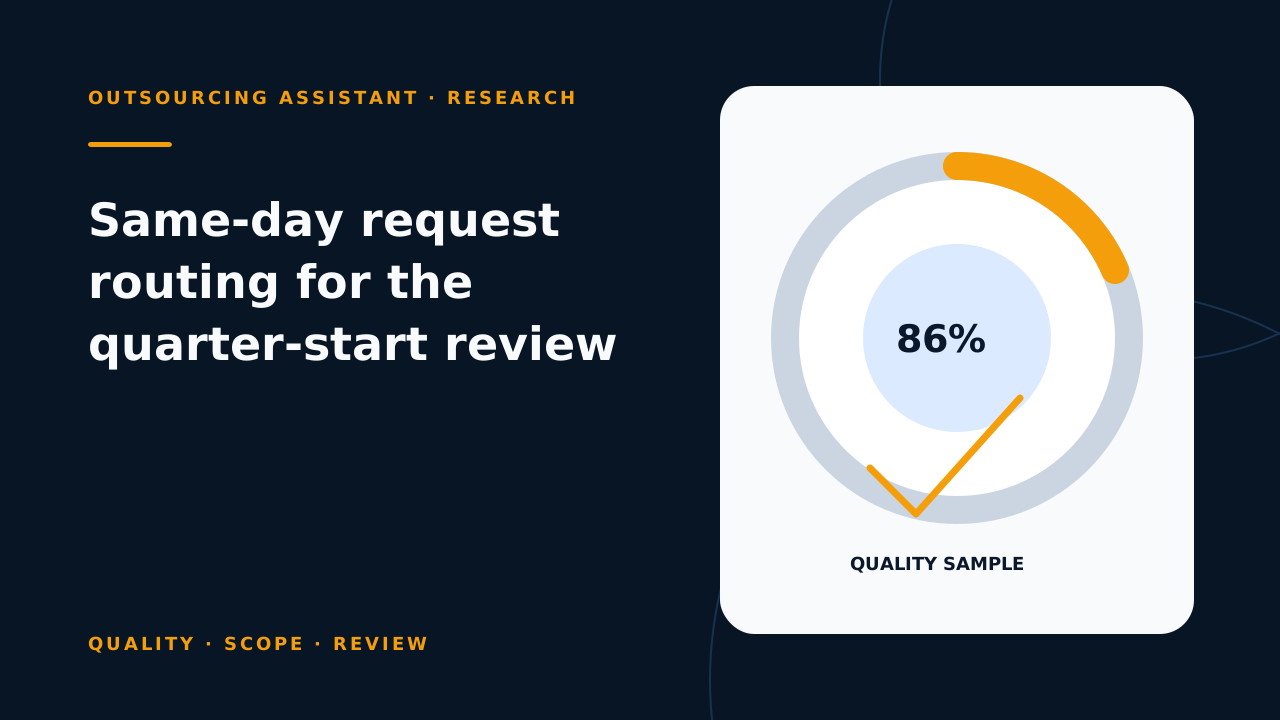
Headline statistic
12 named sources and 12 protocol sections.
Methodology: A desk review of public guidance translated into a repeatable measurement protocol for same-day request evidence.
Key stats
- 12 public sources reviewed
- 12 protocol sections
- November 7, 2026 verification date
Key takeaways
- Define the same-day request unit and the denominator before collecting evidence.
- Report missing, unavailable, and confirmed negative values separately.
- Keep the owner, the evidence date, and the next check visible beside the finding.
Question and scope
The review asks a narrow question about same-day request: can a reviewer reconstruct what happened from the record without asking the assistant who prepared it? Scope is limited to requests logged before 3 p.m. during the stated window. The answer describes the record, not the judgment behind the decision.
Fix the start event, stop event, pause rule, and treatment of missing evidence before collection begins. A dry run on a single case, such as a press interview moved forward, is cheaper than discovering a definition error after the full sample is gathered. Write the definitions in the same note that will hold the results.
| Item | Finding or control | Source |
|---|---|---|
| Unit | same-day request | Method note |
| Window | One quarter-start review cycle | Method note |
Population and unit of analysis
The unit is one same-day request, counted once even when several messages or documents support it. requests logged before 3 p.m. form the population, with linked events attached to the parent item rather than counted separately. Record the inclusion rule beside the count so the denominator cannot be rebuilt after the fact.
Stratify the sample by ordinary items, exceptions, and items returned by a reviewer. That mix keeps a clean average from hiding the cases where the record usually breaks. A small stratified sample is more useful than a large convenient one.
| Item | Finding or control | Source |
|---|---|---|
| Unit | same-day request | Method note |
| Window | One quarter-start review cycle | Method note |
Definitions and measures
The primary measure is share of requests with a decision owner and a promised time. Its denominator is requests accepted in the review window, so a percentage cannot drift toward the easiest items. Report the raw count beside the percentage. A second reviewer should be able to recompute both without opening the original queue.
Define request time, requester, decision owner, and promised time before collection. A field is present only when a reviewer can see the value, its source, and its observation time; an empty box is not a confirmed negative. Mark each field as present, missing, or not applicable before any count is produced.
| Item | Finding or control | Source |
|---|---|---|
| Unit | same-day request | Method note |
| Window | One quarter-start review cycle | Method note |
| Denominator | requests accepted in the review window | Method note |
Evidence standard
Each item must carry the evidence listed in the method note: request time, requester, decision owner, and promised time. A current screenshot cannot prove what the record said earlier, so note the version or observation date. Link the evidence to the item identifier rather than to a folder name that may change.
If the report cannot be reproduced from its origins, treat that as a finding about the record rather than a reason to lower the standard. Keep the collection log with the final package. The log should show who collected each row and when it was last checked.
| Item | Finding or control | Source |
|---|---|---|
| Unit | same-day request | Method note |
| Window | One quarter-start review cycle | Method note |
| Evidence fields | request time, requester, decision owner, and promised time | Method note |
Sampling and collection
Draw twenty requests across two triage slots from the population using a stated rule, and log every exclusion. A convenience sample is acceptable only when the limit is reported beside the result. Record the sampling frame before the first item is opened.
Track the age of the oldest open item along with the count, because an average can conceal one item that sat for weeks. Record the collector, the date, and the system used. Age is part of the evidence, not a separate performance story.
| Item | Finding or control | Source |
|---|---|---|
| Unit | same-day request | Method note |
| Window | One quarter-start review cycle | Method note |
| Sample | twenty requests across two triage slots | Method note |
Analysis and reporting
Report the numerator, the denominator, the window, and the exclusions together. A percentage without those four facts is only a mood. Put the limit in the same paragraph as the finding so it cannot be read as certainty.
Separate missing, unavailable, and confirmed negative values. The distinction tells the reader whether the record failed or the process simply had nothing to record. Combine them once and the result becomes impossible to defend.
| Item | Finding or control | Source |
|---|---|---|
| Unit | same-day request | Method note |
| Window | One quarter-start review cycle | Method note |
| Measure | share of requests with a decision owner and a promised time | Method note |
Limitations and sources of error
This protocol does not measure whether the urgency was real. It also cannot show whether the underlying decision was fair, timely, or wise. Those questions need a different method. State the limit before the finding so the reader can weigh both together.
Common errors include a drifting denominator, a changed definition mid-window, and a reviewer who fills gaps from memory. Each error should be logged when found, not silently corrected. If a definition changes, keep the earlier classification and label the new rule for later items.
| Item | Finding or control | Source |
|---|---|---|
| Unit | same-day request | Method note |
| Window | One quarter-start review cycle | Method note |
Review cadence
Run the check on daily close, weekly pattern review. Keep the definition stable across the window so the comparison means something. A review that changes its question every month cannot show improvement.
At the review, name one process change, one owner, and one check date. A finding without a next action is only a description. Keep the change small enough to verify at the next check.
| Item | Finding or control | Source |
|---|---|---|
| Unit | same-day request | Method note |
| Window | One quarter-start review cycle | Method note |
Data quality checks
Recheck a ten percent sample against the source system. Record disagreement as a finding even when the corrected value looks harmless. The disagreement rate is often more useful than the headline measure.
Confirm that every row has a unique identifier, a source, and an observation time. Duplicate identifiers usually mean two records describe the same event. Resolve duplicates before analysis, not after the report is drafted.
| Item | Finding or control | Source |
|---|---|---|
| Unit | same-day request | Method note |
| Window | One quarter-start review cycle | Method note |
Privacy and retention
Use a pseudonymous item key and keep the crosswalk in an approved system with restricted access. Collect only the fields named in the method note. Access should follow the role, not the seniority of the person asking.
Set a disposal date for the research file and log access to it. An archive without an end date becomes a liability rather than evidence. The disposal date belongs in the method note, not in a private reminder.
| Item | Finding or control | Source |
|---|---|---|
| Unit | same-day request | Method note |
| Window | One quarter-start review cycle | Method note |
Worked example
Take a press interview moved forward. The record shows the opening event, the fields that were checked, the exception that paused it, and the confirmation that closed it. The same example should be usable as a training case at the next review.
A second reviewer should be able to reach the same classification from the saved evidence. If two reviewers disagree, the definition or the evidence standard needs repair. Record the disagreement rather than negotiating a single answer.
| Item | Finding or control | Source |
|---|---|---|
| Unit | same-day request | Method note |
| Window | One quarter-start review cycle | Method note |
Reporting package and handoff
The package contains the method note, the sample list, the completed rows, the exclusions, and a one-page finding. The finding states the limit beside the result. A reader should not need the appendix to understand the main count.
Hand the package to the named owner with daily close, weekly pattern review as the next check. Archive the exact version that was reviewed so a later reader can reproduce the count. The next check should begin from that version, not from a fresh template.
| Item | Finding or control | Source |
|---|---|---|
| Unit | same-day request | Method note |
| Window | One quarter-start review cycle | Method note |
Research notes
## Question and scope
The review asks a narrow question about same-day request: can a reviewer reconstruct what happened from the record without asking the assistant who prepared it? Scope is limited to requests logged before 3 p.m. during the stated window. The answer describes the record, not the judgment behind the decision.
Fix the start event, stop event, pause rule, and treatment of missing evidence before collection begins. A dry run on a single case, such as a press interview moved forward, is cheaper than discovering a definition error after the full sample is gathered. Write the definitions in the same note that will hold the results.
## Population and unit of analysis
The unit is one same-day request, counted once even when several messages or documents support it. requests logged before 3 p.m. form the population, with linked events attached to the parent item rather than counted separately. Record the inclusion rule beside the count so the denominator cannot be rebuilt after the fact.
Stratify the sample by ordinary items, exceptions, and items returned by a reviewer. That mix keeps a clean average from hiding the cases where the record usually breaks. A small stratified sample is more useful than a large convenient one.
## Definitions and measures
The primary measure is share of requests with a decision owner and a promised time. Its denominator is requests accepted in the review window, so a percentage cannot drift toward the easiest items. Report the raw count beside the percentage. A second reviewer should be able to recompute both without opening the original queue.
Define request time, requester, decision owner, and promised time before collection. A field is present only when a reviewer can see the value, its source, and its observation time; an empty box is not a confirmed negative. Mark each field as present, missing, or not applicable before any count is produced.
## Evidence standard
Each item must carry the evidence listed in the method note: request time, requester, decision owner, and promised time. A current screenshot cannot prove what the record said earlier, so note the version or observation date. Link the evidence to the item identifier rather than to a folder name that may change.
If the report cannot be reproduced from its origins, treat that as a finding about the record rather than a reason to lower the standard. Keep the collection log with the final package. The log should show who collected each row and when it was last checked.
## Sampling and collection
Draw twenty requests across two triage slots from the population using a stated rule, and log every exclusion. A convenience sample is acceptable only when the limit is reported beside the result. Record the sampling frame before the first item is opened.
Track the age of the oldest open item along with the count, because an average can conceal one item that sat for weeks. Record the collector, the date, and the system used. Age is part of the evidence, not a separate performance story.
## Analysis and reporting
Report the numerator, the denominator, the window, and the exclusions together. A percentage without those four facts is only a mood. Put the limit in the same paragraph as the finding so it cannot be read as certainty.
Separate missing, unavailable, and confirmed negative values. The distinction tells the reader whether the record failed or the process simply had nothing to record. Combine them once and the result becomes impossible to defend.
## Limitations and sources of error
This protocol does not measure whether the urgency was real. It also cannot show whether the underlying decision was fair, timely, or wise. Those questions need a different method. State the limit before the finding so the reader can weigh both together.
Common errors include a drifting denominator, a changed definition mid-window, and a reviewer who fills gaps from memory. Each error should be logged when found, not silently corrected. If a definition changes, keep the earlier classification and label the new rule for later items.
## Review cadence
Run the check on daily close, weekly pattern review. Keep the definition stable across the window so the comparison means something. A review that changes its question every month cannot show improvement.
At the review, name one process change, one owner, and one check date. A finding without a next action is only a description. Keep the change small enough to verify at the next check.
## Data quality checks
Recheck a ten percent sample against the source system. Record disagreement as a finding even when the corrected value looks harmless. The disagreement rate is often more useful than the headline measure.
Confirm that every row has a unique identifier, a source, and an observation time. Duplicate identifiers usually mean two records describe the same event. Resolve duplicates before analysis, not after the report is drafted.
## Privacy and retention
Use a pseudonymous item key and keep the crosswalk in an approved system with restricted access. Collect only the fields named in the method note. Access should follow the role, not the seniority of the person asking.
Set a disposal date for the research file and log access to it. An archive without an end date becomes a liability rather than evidence. The disposal date belongs in the method note, not in a private reminder.
## Worked example
Take a press interview moved forward. The record shows the opening event, the fields that were checked, the exception that paused it, and the confirmation that closed it. The same example should be usable as a training case at the next review.
A second reviewer should be able to reach the same classification from the saved evidence. If two reviewers disagree, the definition or the evidence standard needs repair. Record the disagreement rather than negotiating a single answer.
## Reporting package and handoff
The package contains the method note, the sample list, the completed rows, the exclusions, and a one-page finding. The finding states the limit beside the result. A reader should not need the appendix to understand the main count.
Hand the package to the named owner with daily close, weekly pattern review as the next check. Archive the exact version that was reviewed so a later reader can reproduce the count. The next check should begin from that version, not from a fresh template.
## Sources
- [NIST Cybersecurity Framework 2.0](https://www.nist.gov/cyberframework) — checked November 7, 2026.
- [NIST SP 800-53 Rev. 5](https://csrc.nist.gov/pubs/sp/800/53/r5/upd1/final) — checked November 7, 2026.
- [NIST SP 800-61 Rev. 2](https://csrc.nist.gov/pubs/sp/800/61/r2/final) — checked November 7, 2026.
- [CISA Secure Our World](https://www.cisa.gov/secure-our-world) — checked November 7, 2026.
- [U.S. Small Business Administration](https://www.sba.gov/) — checked November 7, 2026.
- [U.S. Department of Labor](https://www.dol.gov/) — checked November 7, 2026.
- [GAO Green Book](https://www.gao.gov/products/gao-14-704g) — checked November 7, 2026.
- [FTC Data Security](https://www.ftc.gov/business-guidance/privacy-security/data-security) — checked November 7, 2026.
- [ICO Data Protection Principles](https://ico.org.uk/for-organisations/uk-gdpr-guidance-and-resources/data-protection-principles-a-guide-to-the-data-protection-principles/) — checked November 7, 2026.
- [International Labour Organization](https://www.ilo.org/) — checked November 7, 2026.
- [GSA Acquisition Gateway](https://acquisitiongateway.gov/) — checked November 7, 2026.
- [Project Management Institute](https://www.pmi.org/) — checked November 7, 2026.
Put this control into a role brief
Use the definitions and evidence standard when scoping the role.
Keep the executive decision with the executive.
Questions people ask
What does this protocol measure?
It measures what the same-day request record can show about evidence, ownership, and closure. It does not rate the quality of the underlying decision.
What is the main limitation?
The protocol does not measure whether the urgency was real. A reproducible count is still only a description, not a verdict about the team.
Sources
- NIST Cybersecurity Framework 2.0: Public risk-management framework used for governance and review language.
- NIST SP 800-53 Rev. 5: Control guidance for access, audit, and record integrity.
- NIST SP 800-61 Rev. 2: Public incident-handling guidance used for exception routing.
- CISA Secure Our World: Practical guidance on verification and urgent requests.
- U.S. Small Business Administration: Small-business operations and planning guidance.
- U.S. Department of Labor: Public labor guidance used for scheduling and travel context.
- GAO Green Book: Internal control standards for evidence and authority.
- FTC Data Security: Business data-security principles and enforcement context.
- ICO Data Protection Principles: Purpose limitation, minimisation, accuracy, and retention guidance.
- International Labour Organization: International labor standards and remote-work context.
- GSA Acquisition Gateway: Public procurement and contract-management resources.
- Project Management Institute: Public project-management standards and ethics guidance.